


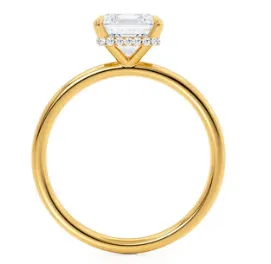
An Asscher-cut diamond does not rely on a shower of sparkle to make an impression. Its appeal lies in precision: a sequence of broad, symmetrical facets that draws the eye towards the centre of the stone. This architectural appearance can feel distinctly Art Deco, yet it works equally well in restrained contemporary jewellery.
Because the cut reveals more of the diamond’s interior than many brilliant styles, choosing well requires a thoughtful eye. Those exploring ascher cut diamonds by Lily Arkwright can consider petite solitaires, hidden-halo designs and different 18k gold finishes, making it possible to assess the stone as part of a complete composition rather than in isolation.
Look Beyond the Laboratory Certificate
A grading report provides useful information, but it cannot fully describe how an Asscher-cut diamond will appear in person. Two stones with comparable colour, clarity and carat weight may differ noticeably in symmetry, depth and visual liveliness.
Begin with the outline. A classic Asscher should appear square, with evenly clipped corners and a balanced octagonal silhouette. The concentric facets should create a clean “hall-of-mirrors” effect, drawing the gaze inward without producing distracting dark areas.
Pay particular attention to the centre of the stone. Some contrast is desirable because it defines the geometric pattern. However, a diamond that appears persistently black or lifeless through its centre may have proportions that restrict the return of light. Viewing videos from several angles is therefore more informative than relying on a face-up photograph alone.
Prioritise Clarity and Colour Carefully
Step-cut diamonds have long, open facets rather than the smaller, fragmented facets associated with round brilliant cuts. This elegant structure also means inclusions may be easier to see.
That does not automatically make the highest clarity grade the best purchase. The practical aim is an eye-clean diamond: one without visible inclusions under normal viewing conditions. The position and nature of an inclusion matter as much as its grade. A small mark near a clipped corner may be concealed by a claw, while a dark inclusion beneath the central table is likely to remain noticeable.
Colour should be judged alongside the chosen metal. White gold creates a crisp frame and may make warmth in the diamond more apparent, encouraging buyers to favour a higher colour grade. Yellow or rose gold can complement slightly warmer stones, allowing the design to feel harmonious without paying for a colour distinction that may be difficult to perceive once set.
Match Carat Weight to Proportions and Setting
Asscher cuts often appear smaller face-up than elongated or brilliant-cut diamonds of the same weight because more of their mass can be carried through the depth of the stone. Dimensions in millimetres are consequently essential when comparing options.
A two-carat stone does more than offer greater surface area than a one-carat diamond. Its broader facets can make the internal geometry easier to appreciate, creating stronger visual presence in a simple solitaire. A smaller stone, however, may look particularly refined in a petite setting or alongside a slim pavé band.
The setting should support the Asscher’s shape rather than obscure it. Fine corner claws preserve the octagonal outline, while a hidden halo adds light and detail beneath the centre stone without competing with its disciplined face-up pattern. A plain band produces a more architectural result; pavé introduces contrast and additional brilliance.
Consider the Jewellery as a Complete Design
An Asscher-cut lab diamond should be evaluated in relation to the wearer’s hand, lifestyle and existing jewellery. A high-set centre stone can appear dramatic and allow a wedding band to sit closely beside it, but a lower profile may feel more practical for everyday wear.
Band width also affects proportion. A delicate band can make the centre diamond appear larger, while a broader band lends visual weight and may suit a more substantial stone. Metal colour, claw shape and gallery detailing should all reinforce the diamond’s geometry.
Final Thought
The finest Asscher-cut lab diamond is not simply the stone with the most impressive certificate. It is the one whose symmetry, clarity and proportions remain compelling as the light changes—and whose setting allows that distinctive geometry to take centre stage. By evaluating the diamond and jewellery design together, buyers can choose a piece that feels considered, balanced and enduring.